
In a significant judgment delivered around late March 2026, the Supreme Court of India reaffirmed a crucial principle of criminal justice: prolonged incarceration without trial cannot be justified. The ruling underscores the importance of safeguarding the rights of the accused and ensuring that the process of law does not itself become punitive.
Background of the Case
The case concerned Pardeep Kumar (also known as Banu), a resident of Punjab, who had been in judicial custody for nearly two years. He was booked in February 2024 on charges including attempt to murder and other related offences.
Despite the seriousness of the allegations, the trial had not commenced during this period. The prosecution had listed 23 witnesses, yet none had been examined even after two years of detention. This delay became a central issue before the Court.
Supreme Court Bench and Decision
The matter was heard by a bench comprising Justices Dipankar Datta and P.V. Varale. The Court allowed the appeal filed by the accused and set aside the order of the Punjab and Haryana High Court dated July 11, 2025, which had earlier denied bail.
Granting relief to the accused, the Supreme Court directed that bail be granted, subject to strict conditions. These included the submission of bail bonds and safeguards to ensure that the accused does not influence witnesses.
Key Principle Laid Down
A central observation made by the Court was that:
“Incarceration without trial amounts to punishment.”
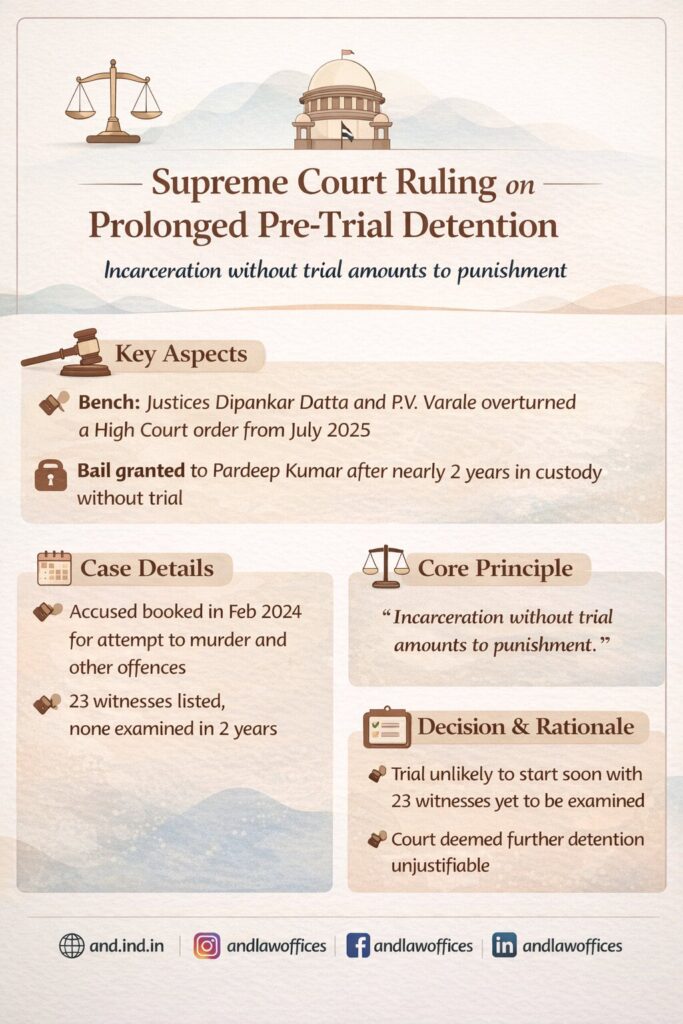
This statement reflects a fundamental principle of criminal law—that an accused person is presumed innocent until proven guilty. Detention prior to conviction is meant to serve procedural purposes, such as ensuring the presence of the accused during trial, and not to function as a substitute for punishment.
Rationale Behind the Judgment
The Court took into account the fact that none of the 23 prosecution witnesses had been examined, indicating that the trial had not meaningfully progressed. Given the number of witnesses and the pace of proceedings, the Court observed that the trial was likely to take a considerable amount of time.
In such circumstances, continued detention of the accused would be unjustifiable, as it would effectively result in punishment without adjudication of guilt.
The Court therefore balanced the interests of justice with the rights of the accused, concluding that further custody could not be sustained.
Significance of the Judgment
This ruling highlights the judiciary’s commitment to protecting individual liberty and ensuring fairness in criminal proceedings. It reinforces that:
- Delays in trial cannot be used to justify indefinite detention
- The right to a timely trial is an essential aspect of justice
- Pre-trial custody must remain reasonable and proportionate
By granting bail in this case, the Supreme Court emphasized that procedural delays cannot override fundamental rights.
Conclusion
The Supreme Court’s decision serves as an important reminder that the criminal justice system must not lose sight of its foundational principles. While addressing serious offences is essential, it must be done within the framework of fairness and due process. Prolonged detention without trial undermines these principles and risks turning the process itself into punishment—something the Court has firmly rejected in this judgment.