The Hindu Marriage Act, 1955 provides a structured legal framework governing the validity of marriages among Hindus. Within this framework, Sections 11 and 12 deal specifically with situations where a marriage is either void or voidable, thereby offering remedies to parties where the marriage suffers from legal defects.
Section 11: Void Marriages
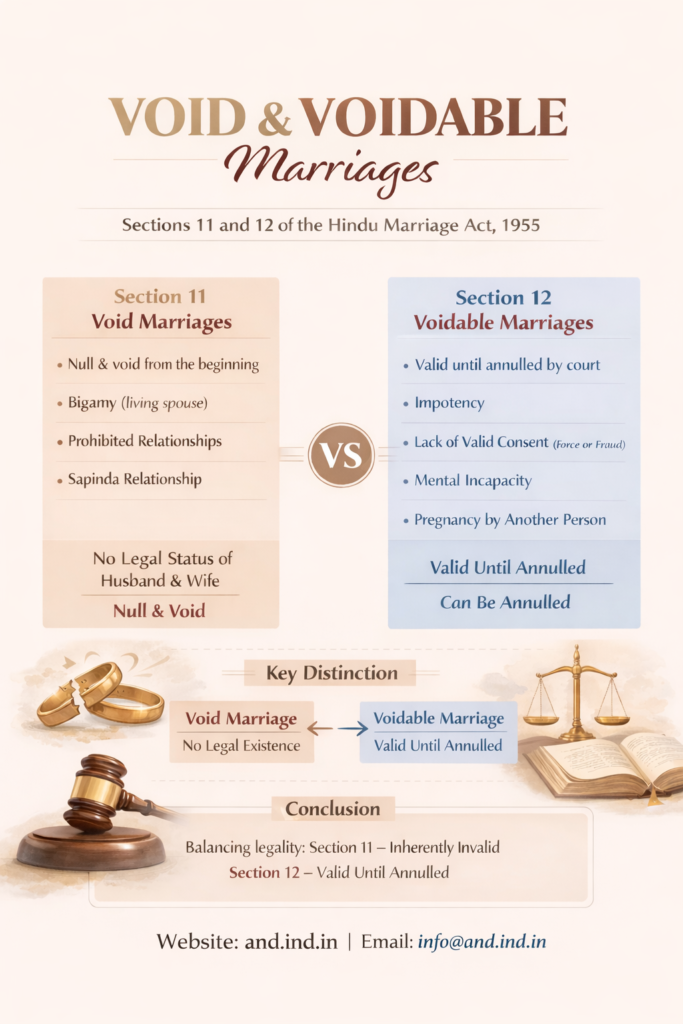
Section 11 deals with void marriages, which are marriages that are considered null and void from the very beginning (void ab initio). This means that in the eyes of law, such a marriage never legally existed. The court, through a decree of nullity, merely declares an already existing fact.
A marriage is considered void if it violates certain essential conditions laid down under Section 5 of the Act, specifically:
- Bigamy: If either party has a living spouse at the time of marriage, the subsequent marriage is void.
- Prohibited relationships: If the parties fall within degrees of prohibited relationship.
- Sapinda relationship: If the parties are related within sapinda relationships, unless permitted by custom.
Among these, bigamy is one of the most prominent grounds. The Act not only declares such marriages void but also makes them punishable under the Indian Penal Code.
Thus, a void marriage confers no legal status of husband and wife, and the parties are treated as if no valid marriage ever took place.
Section 12: Voidable Marriages
Section 12 deals with voidable marriages, which differ significantly from void marriages. A voidable marriage is valid and subsisting unless and until it is annulled by a decree of the court.
Such marriages are considered legally valid at the outset, but they contain certain defects that allow one party to seek annulment.
The grounds on which a marriage may be declared voidable include:
- Impotency: If the marriage has not been consummated due to the impotence of the respondent.
- Lack of valid consent: Where consent was obtained by force or fraud regarding the nature of the ceremony or material facts about the respondent.
- Mental incapacity: Where one party was incapable of giving valid consent due to mental disorder.
- Pregnancy by another person: If the respondent was pregnant by another person at the time of marriage.
Unlike void marriages, a voidable marriage continues to have legal validity until the aggrieved party approaches the court and obtains a decree of annulment.
Key Distinction Between Void and Voidable Marriages
The primary distinction lies in their legal status:
- A void marriage is automatically invalid and has no legal existence.
- A voidable marriage remains valid unless challenged and annulled by the court.
Additionally, Sections 11 and 12 serve as remedial provisions, allowing parties to exit marriages that either violate fundamental legal conditions or suffer from specific defects.
Conclusion
Sections 11 and 12 of the Hindu Marriage Act, 1955 play a crucial role in ensuring that marriages conform to legal standards. While Section 11 addresses marriages that are inherently invalid, Section 12 provides relief in cases where consent or circumstances surrounding the marriage are flawed. Together, these provisions strike a balance between preserving the institution of marriage and protecting individuals from unlawful or unjust marital relationships.
Recent Posts
- Supreme Court on Prolonged Pre-Trial Detention: A Violation of Rights
- Section 13 of the Hindu Marriage Act, 1955: Grounds of Divorce
- Judicial Separation under Hindu Law: A Legal Perspective
- Sections 11 and 12 of the Hindu Marriage Act, 1955: Void and Voidable Marriages
- Digital Personal Data Protection Act, 2023-Key Compliance Requirements under the Legal Framework
- Digital Personal Data Protection Act, 2023Applicability of the Act to Companies and Organisations
- Digital Personal Data Protection Act, 2023,Implications and Consequences of Non-Compliance, including Relevant Penalties
- Digital Personal Data Protection Act, 2023, Legislative Evolution: Withdrawal of the 2019 Bill and Enactment of the DPDP Framework
- Digital Personal Data Protection Act, 2023- Legislative Evolution: The Personal Data Protection Bill, 2019 and the JPC Process
- The Digital Personal Data Protection (DPDP) Act, 2023,Constitutional Roots and Legislative Evolution