
The Hindu Marriage Act, 1955 marked a significant shift in Indian matrimonial law by introducing the concept of divorce, which was traditionally not recognised in Hindu marriages. Section 13 of the Act lays down the grounds on which either spouse can seek dissolution of marriage, thereby providing a legal mechanism to exit a marital relationship that has broken down.
Introduction to Section 13
Section 13 is one of the most important provisions of the Act as it enables either the husband or the wife to file a petition for divorce. This provision recognises that a marriage may fail due to various reasons and provides structured legal grounds to address such situations.
General Grounds for Divorce
Under Section 13(1), a marriage may be dissolved on specific grounds where one spouse is at fault. These include:
- Adultery
If one spouse has engaged in voluntary sexual intercourse with any person other than their spouse after the marriage, it constitutes a valid ground for divorce.
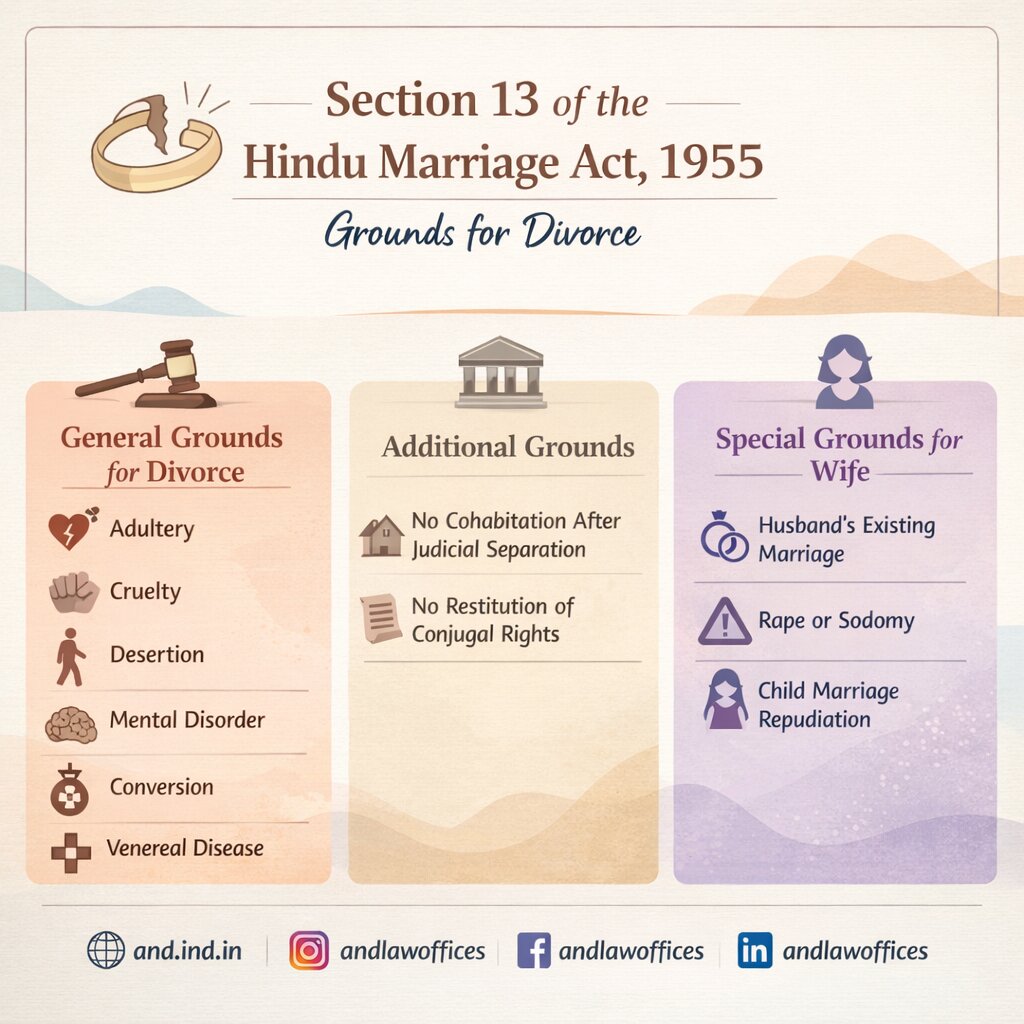
- Cruelty
Cruelty includes both physical and mental harm inflicted by one spouse on the other, making it unreasonable for the aggrieved party to continue the marital relationship.
- Desertion
If one spouse deserts the other for a continuous period of at least two years without reasonable cause and without consent, it becomes a ground for divorce.
- Conversion
If a spouse ceases to be a Hindu by converting to another religion, the other spouse may seek divorce.
- Mental Disorder
If a spouse suffers from an incurable mental disorder or mental illness to such an extent that the other spouse cannot reasonably be expected to live with them, divorce may be granted.
- Venereal Disease and Renunciation
Divorce can also be sought if a spouse suffers from a communicable venereal disease or renounces the world by entering a religious order.
- Presumption of Death
If a spouse has not been heard of as being alive for a period of seven years, the other spouse may file for divorce.
Additional Grounds for Divorce
Section 13(1A) provides additional grounds based on non-compliance with court decrees:
- If there has been no resumption of cohabitation after a decree of judicial separation for one year or more
- If there has been no restitution of conjugal rights for one year or more after a court decree
These provisions recognise that continued separation despite legal intervention indicates a breakdown of marriage.
Special Grounds Available to Wife
Section 13(2) provides additional rights exclusively to the wife, including:
- Husband having another wife living at the time of marriage
- Husband being guilty of rape, sodomy, or bestiality
- Non-resumption of cohabitation after a maintenance order
- Marriage solemnised before the wife attained a certain age and later repudiated
These provisions aim to provide greater protection to women within the marital framework.
Nature and Purpose of Section 13
Section 13 reflects the transformation of Hindu marriage from a purely sacramental bond to one that also recognises individual rights and autonomy. It provides a legal remedy for irretrievable breakdown of marriage, ensuring that individuals are not forced to remain in oppressive or unworkable relationships.
Conclusion
Section 13 of the Hindu Marriage Act, 1955 serves as the foundation of divorce law in India. By clearly outlining the grounds for dissolution of marriage, it balances the sanctity of marriage with the need to protect individuals from injustice and hardship. The provision thus plays a crucial role in modern matrimonial law by offering a structured and fair approach to ending marital relationships.