Judicial separation under Hindu law is an important legal remedy available to married couples who wish to live separately without dissolving their marriage. It is governed by Section 10 of the Hindu Marriage Act, 1955, and serves as an alternative to divorce, allowing spouses to take a step back from the marital relationship while still retaining their legal status as husband and wife.
Meaning and Nature of Judicial Separation
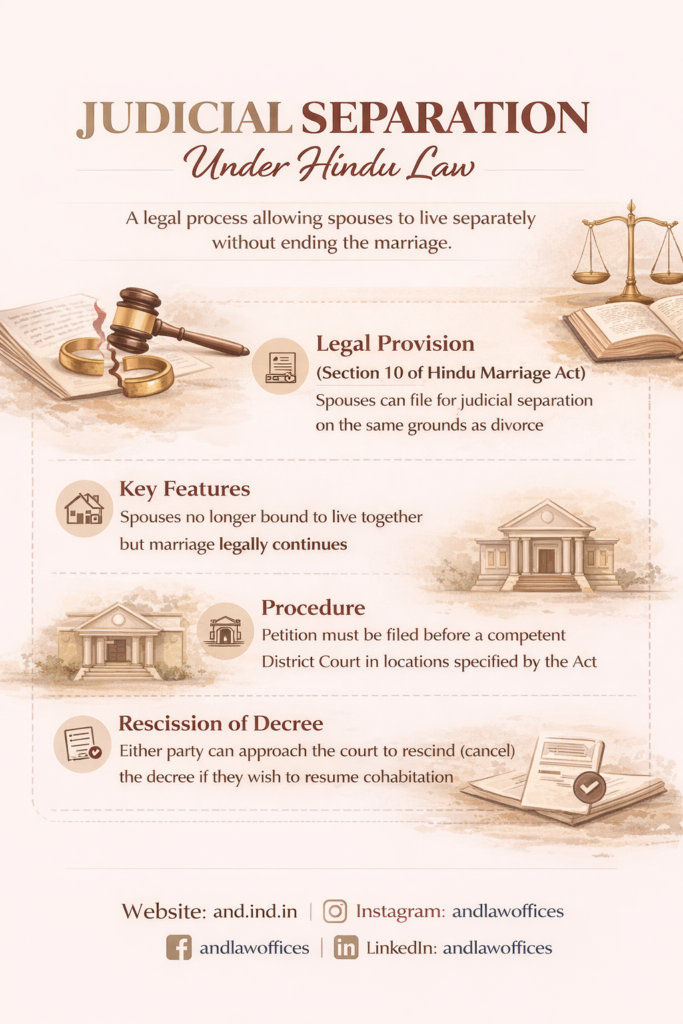
Judicial separation refers to a situation where the court permits spouses to live apart without terminating the marriage. Unlike divorce, which completely ends the marital bond, judicial separation merely suspends certain marital obligations, particularly the duty to cohabit.
This concept is significant because it provides couples with an opportunity to resolve conflicts or reassess their relationship without taking the irreversible step of divorce. It acts as a middle path between continuing a troubled marriage and completely dissolving it.
Legal Provision under Section 10
Section 10 of the Hindu Marriage Act lays down the framework for judicial separation. Under this provision:
- Either spouse (husband or wife) can file a petition for judicial separation.
- The petition can be filed on the same grounds as divorce, as specified under Section 13 of the Act.
- Once the court grants a decree, the spouses are no longer obligated to cohabit and are legally allowed to live separately.
Thus, judicial separation legally recognises separation without breaking the marital tie.
Procedure for Filing Petition
A petition for judicial separation must be filed before a competent District Court. The Act provides that such a petition can be filed in places such as:
- Where the marriage was solemnised
- Where the respondent resides
- Where the parties last resided together
- In certain cases, where the petitioner resides
This ensures accessibility and convenience for the parties seeking relief.
Effect of Judicial Separation
Once a decree of judicial separation is granted:
- The spouses are no longer bound to live together
- The marriage continues to exist legally
- The parties remain husband and wife in the eyes of law
Therefore, judicial separation does not end the marriage but only suspends certain marital rights and duties.
Rescission of Decree
An important feature of judicial separation is its reversible nature. Either party can approach the court to rescind (cancel) the decree if they wish to resume cohabitation. The court may grant such a request if it finds it just and reasonable.
This reflects the law’s intent to encourage reconciliation wherever possible.
Conclusion
Judicial separation under the Hindu Marriage Act, 1955 is a crucial legal mechanism that balances the sanctity of marriage with individual autonomy. It provides spouses with a structured way to live apart while preserving the marital bond. By allowing separation without dissolution and permitting reconciliation through rescission, the law ensures flexibility in addressing marital disputes. Ultimately, judicial separation acts as a protective and corrective measure, offering couples time and space to decide the future of their relationship.
Recent Posts
- Navigating DPDP Compliance Service in Delhi: Legal Insights for Data Fiduciaries
- DPDP Compliance Service in Delhi: Regulatory Framework and Business Responsibilities
- A Practical Guide to DPDP Compliance Service in Delhi for Organizations
- DPDP Compliance Service in Delhi: Key Legal Obligations Under the DPDP Act, 2023
- Understanding DPDP Compliance Service in Delhi: ALegal Perspective for Businesses
- DPDP Compliance Service in Delhi: An Informational Overview of Legal Requirements
- Supreme Court on Tax Classification of Rooh Afza: A Landmark VAT Ruling
- Supreme Court on Prolonged Pre-Trial Detention: A Violation of Rights
- Section 13 of the Hindu Marriage Act, 1955: Grounds of Divorce
- Judicial Separation under Hindu Law: A Legal Perspective
- Sections 11 and 12 of the Hindu Marriage Act, 1955: Void and Voidable Marriages
- Digital Personal Data Protection Act, 2023-Key Compliance Requirements under the Legal Framework
- Digital Personal Data Protection Act, 2023Applicability of the Act to Companies and Organisations
- Digital Personal Data Protection Act, 2023,Implications and Consequences of Non-Compliance, including Relevant Penalties
- Digital Personal Data Protection Act, 2023, Legislative Evolution: Withdrawal of the 2019 Bill and Enactment of the DPDP Framework
- Digital Personal Data Protection Act, 2023- Legislative Evolution: The Personal Data Protection Bill, 2019 and the JPC Process
- The Digital Personal Data Protection (DPDP) Act, 2023,Constitutional Roots and Legislative Evolution